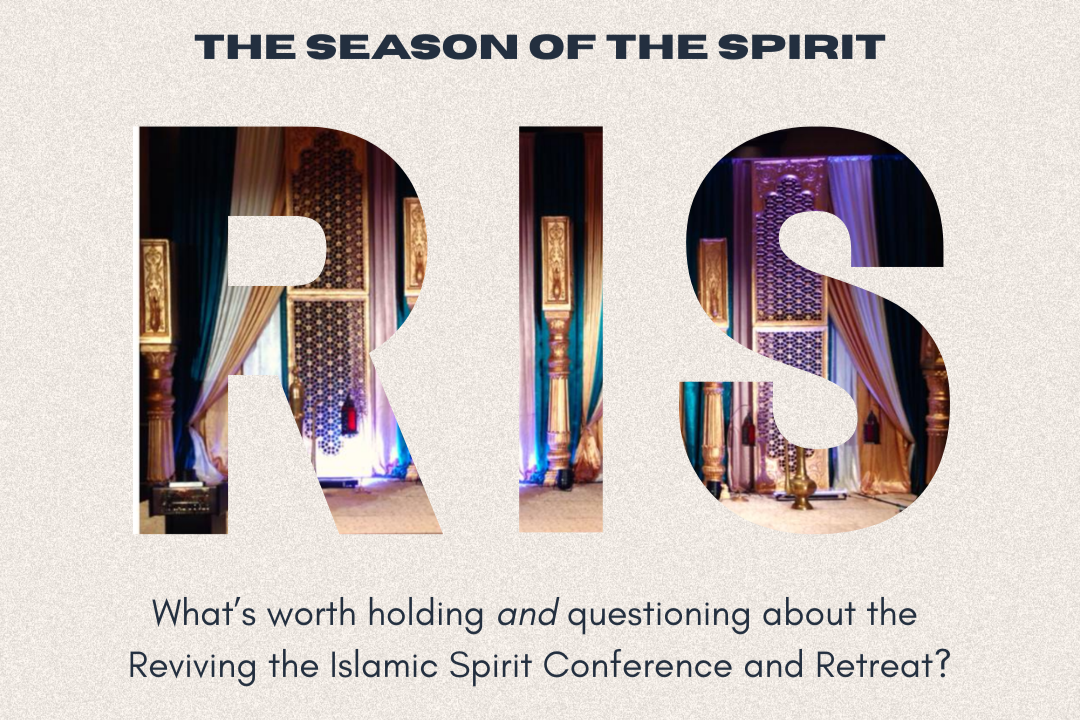
The Season of the Spirit: What’s worth holding and questioning about the Reviving the Islamic Spirit Conference and Retreat?
What is RIS?
As RIS approaches it’s worth holding both appreciation and accountability about how this conference is situated within our religious learning ecosystem.
It is not a call to disengage, but a call to attend more carefully.
RIS is a large-scale annual conference held over a weekend in Toronto, attracting over 25,000 attendees. This year, 25 speakers are listed—20 men and 5 women.
A week-long Knowledge Retreat follows, serving a few hundred participants. This year, 8 teachers are platformed—7 men and 1 woman.
Scale matters because scale shapes authority.
Learning Conferences
Large-scale Muslim conferences hold value and tension by:
- gathering thousands of Muslims around shared language, ritual, and longing
- offering access to scholars and teachers many would never encounter locally
- offering moments of inspiration that can spark real shifts in direction, practice, and belonging.
- providing families and friends from different cities a gathering point to meet and learn
And:
- transmitting selective bodies of religious knowledge and comportment.
- advancing specific narratives about what authentic Muslim practice and priorities look like.
- shaping and limiting religious imagination.
– influencing who is seen as authoritative and who is not.
For many, RIS has been a doorway into learning, into community, and into faith felt as collective rather than individual.
It is because of this power that conferences like RIS require scrutiny.
Conferences like RIS raise questions we must ask:
Who is platformed and who is excluded?
How are these conferences sites of awakening and/or sites of extraction?
What kinds of knowledge are made visible, legitimate, legible, and marketable? And who decides?
Are feelings of inspiration motivators or a gateway drug into — one more talk, one more clip, one more high—without structures to hold what was stirred?
This isn’t about assuming bad faith on the part of organisers or speakers.
It’s about systems. It's about how religious learning becomes packaged, scaled, branded, and sold in ways that position the accumulation of knowledge as the solution to a perceived crisis while ignoring the acute demand of embodied knowledge and ethical leadership.
Capitalism & Labour
RIS is an actor in the Muslim Education Industrial Complex. It is an opaque financial structure that relies heavily on volunteer labour.
It sells out year after year, yet offers no meaningful public financial transparency about how revenue circulates, who benefits, or how labour is valued.
When religious learning is profitable but labour is unpaid and framed as khidma, it can normalize extraction.
This shapes not just institutions, but expectations of service, sacrifice, and silence. is isn’t only an economic issue. It is a spiritual one.
Who speaks for Islam?
When conferences repeatedly platform:
overwhelmingly male teachers
limited racial representation
the same networks of authority
they communicate:
whose knowledge is considered normative
who is positioned as teacher or student
what Islam looks like in public
These patterns are systemic and not accidental. They are not about individual speakers or organisers acting in bad faith. Power and authority reproduce themselves.
Where legitimacy is inherited, platforms circulate among the same few, and diversity is treated as optional rather than foundational.
The Role of the Learner
The Muslim Education Industrial Complex is not sustained by institutions alone.
Learners are active participants and carry responsibility. Ethical learning requires us to ask ourselves:
Who is shaping me? Why?
Toward what direction am I being formed?
What knowledge do I and my community need now? Why?
When does inspiration become consumption?
What am I supporting with my presence or silence?
Discernment is an individual and collective responsibility.
So the question isn’t whether RIS should exist or even if we should attend.
The question is this: What kind of Muslims do our learning structures produce and at what cost?
Not every popular voice is a prophetic one.
The sacred is shaped by markets.
Learning is not neutral.
Knowing is not the same as becoming.
Formation always has consequences. We are accountable for how we choose to be formed
I’m holding both gratitude and critique as RIS approaches.
Both appreciation for what these gatherings have offered and a hope that our conversations about knowledge, learning, and Muslim practice keep deepening, not flattening.
If Muslim education is going to shape our futures, then how it is organised, funded, and represented matters as much as what is taught from the stage.
This reflection draws from my research on Islamic education, authority, and formation. Read my full chapter exploring RIS and its constructions in my book Knowledge, Authority, and Islamic Education in the West: Reconfiguring Tradition.